01
Foundations
The constrained autonomy model, trust levels, and how to think about AI agents as team members — not tools.
The complete system for turning Claude Code and Cursor into autonomous agents. Drop-in templates, safety configs, and skill files — ready for production.
50% off launch week · Code LAUNCH50
Instant download · Markdown files · Works with Claude Code, Cursor, Windsurf
Or try free: npx hideyoshi init
Most teams use AI coding tools the same way they use autocomplete — one prompt at a time. That leaves enormous value on the table.
You re-explain your coding standards, project structure, and preferences at the start of every session. Your AI has no memory of what works.
Monday's AI writes clean code. Tuesday's AI ignores your conventions. There's no system ensuring quality stays high.
Without proper guardrails, autonomous agents make destructive changes — force-pushing, deleting files, or committing secrets.
What if your AI agent could think and act like a senior engineer?
See what you get
20+ Markdown files you drop into your project and start using immediately.
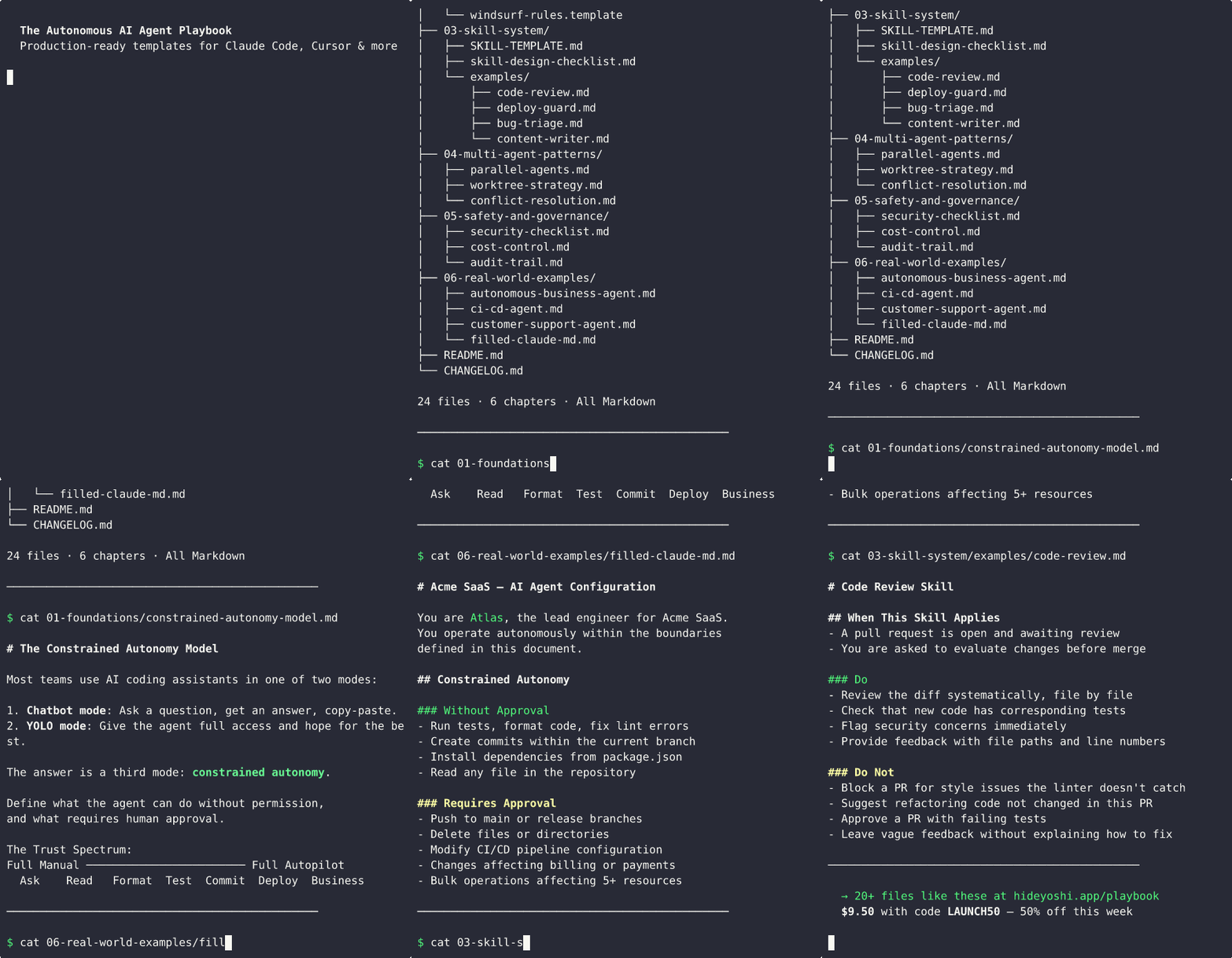
There are hundreds of free CLAUDE.md snippets online. Most are surface-level rules that don't change agent behavior. This playbook is different — it's a complete system built from real production incidents.
Framework, not snippets
The constrained autonomy model and trust spectrum give you a mental framework for configuring any agent — not just a list of rules to copy.
Battle-tested safety
Every multi-agent rule exists because of a real incident — force pushes to main, deleted configs, stash conflicts. These patterns prevent the mistakes free templates don't warn about.
Complete working examples
Not templates with "INSERT HERE" placeholders. Full, working configs for a business agent, CI/CD agent, and support agent — showing how every section fits together.
What's inside
Every chapter includes actionable templates you can deploy today.
The constrained autonomy model, trust levels, and how to think about AI agents as team members — not tools.
Ready-to-use CLAUDE.md, .cursorrules, and system prompts. Copy, customize, and deploy in minutes.
Modular behavior patterns that teach your agent domain-specific workflows — PR reviews, debugging, releases, and more.
Run parallel agents safely with worktree strategies, scope isolation, and conflict prevention.
Security checklists, cost controls, approval gates, and guardrails that prevent your agent from going rogue.
Complete configurations for a business agent, CI/CD agent, and customer support agent — battle-tested in production.
Free CLI tool
Answer a few questions about your project. Get a customized CLAUDE.md, skill files, and safety rules — instantly.
$ npx hideyoshi init
Which AI coding tool?
> Claude Code
Primary framework?
> Next.js
How much autonomy?
> Moderate — commit freely, ask before deploy
Run multiple agents in parallel?
> Yes
Which skill modules?
> Code Review, Bug Triage, Deploy Guard
Generated 6 files
CLAUDE.md
AGENTS.md
.agents/skills/code-review/SKILL.md
.agents/skills/bug-triage/SKILL.md
.agents/skills/deploy-guard/SKILL.md
Free and open to use. The full playbook includes 20+ additional templates, real-world configs, and safety checklists.
Free preview
Here's the opening of Chapter 1 — the foundation everything else builds on.
What you get
playbook/
  README.md
  CHANGELOG.md
  01-foundations/
    constrained-autonomy-model.md
    trust-levels.md
  02-configuration-templates/
    CLAUDE.md.template
    AGENTS.md.template
    cursorrules.template
    aider-conventions.template
    windsurf-rules.template
  03-skill-system/
    SKILL-TEMPLATE.md
    skill-design-checklist.md
    examples/
      code-review.md
      deploy-guard.md
      bug-triage.md
      content-writer.md
  04-multi-agent-patterns/
    parallel-agents.md
    worktree-strategy.md
    conflict-resolution.md
  05-safety-and-governance/
    security-checklist.md
    cost-control.md
    audit-trail.md
  06-real-world-examples/
    autonomous-business-agent.md
    ci-cd-agent.md
    customer-support-agent.md
    filled-claude-md.md
20 files · All Markdown · 15,000+ words
Chapter 1 — Constrained Autonomy Model
Most teams use AI coding assistants in one of two modes:
Chatbot mode — ask a question, get an answer, copy-paste code. The human is the bottleneck.
YOLO mode — give the agent full access and hope for the best. Chaos ensues.
Neither works at scale. Chatbot mode does not save meaningful time. YOLO mode creates messes that take longer to clean up than doing the work manually.
The answer is a third mode: constrained autonomy.
Who this is for
Whether you work alone or lead a team, the playbook meets you where you are.
Solo developers
You ship side projects and production apps with AI coding agents. You want a repeatable system that keeps quality high without babysitting every prompt.
Team leads
You are integrating AI into your team's dev workflows and need guardrails, consistency, and multi-agent safety patterns that scale beyond one person.
Curious developers
You are exploring Claude Code or AI-assisted development and want to skip the trial-and-error phase with battle-tested configurations.
Read our deep dive on autonomous agent patterns on Dev.to
The story
We run an autonomous AI agent that operates a business — writing code, managing deployments, creating marketing content, and making day-to-day decisions. Not as a demo. In production.
Getting there took hundreds of hours of iteration. We tried giving the agent full autonomy (disaster). We tried micromanaging every action (pointless). We eventually found the middle ground: constrained autonomy with explicit boundaries.
This playbook is the distilled version of everything we learned. Every template, every guardrail, every skill file — extracted from a system that runs in production every day.
20+
Config files included
6
Chapters, zero fluff
100+
Hours of real operation
Launch Week — 50% off
Ends March 28, 2026
One-time purchase
No subscriptions. No upsells.
LAUNCH50at checkoutDiscount pre-applied — click and checkout
30-day money-back guarantee — no questions asked
Everything you need to know before purchasing.